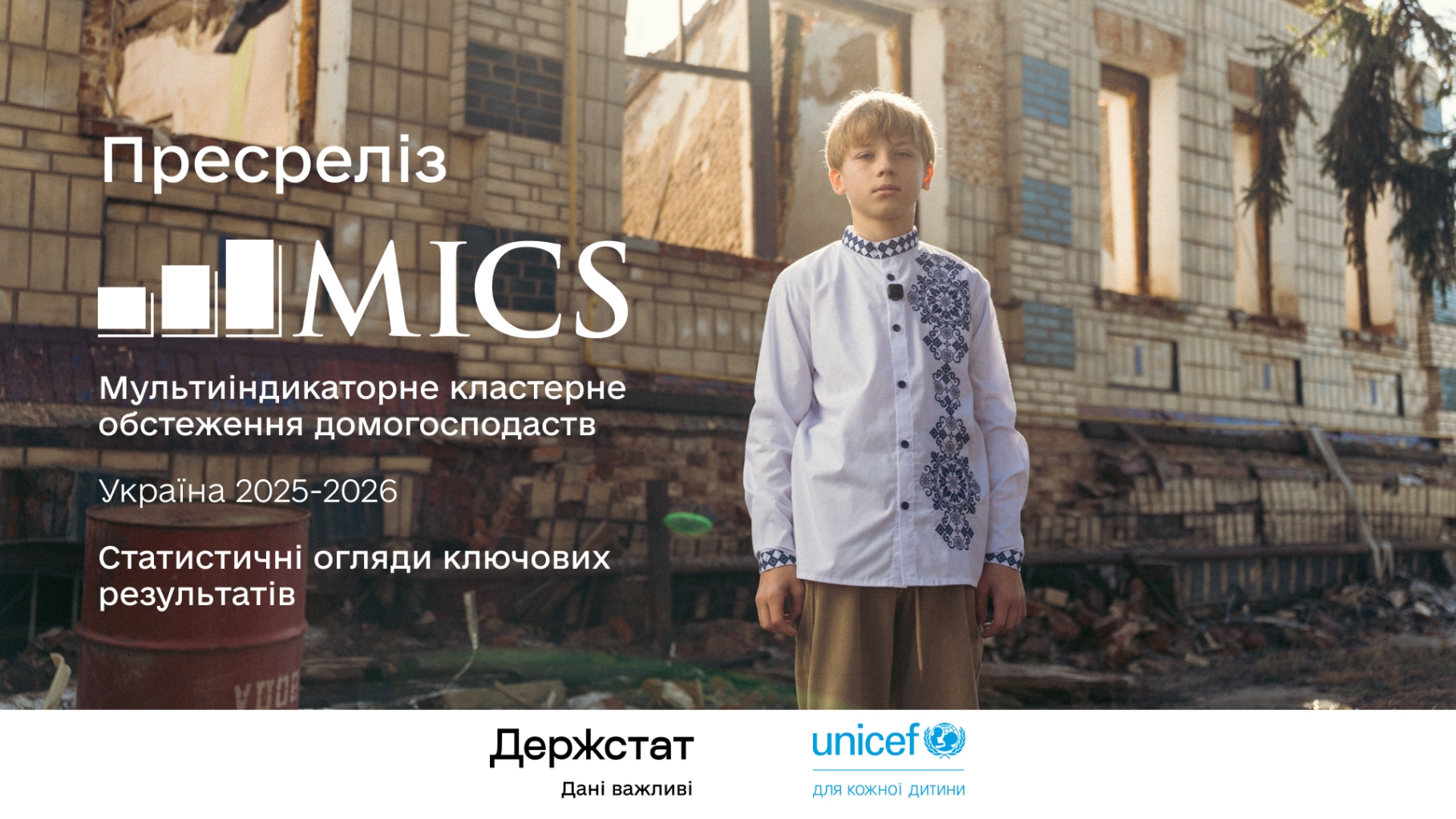
Largest household survey in Ukraine for 14-years reveals the holistic impact of the war on people’s lives to inform policies and actions which respond to children and young people wherever they are.
KYIV, 11 June 2026 – New survey findings released today by the State Statistics Services of Ukraine and UNICEF, capture the specific effects of the war on children and families' lives, revealing demographic shifts and wide ranging yet unequal impacts, alongside progress such as in a reduction of violent discipline against children.
The largest ever household survey during wartime, and the first Multiple Indicator Cluster Survey (MICS) in Ukraine for 14-years, covered nearly 16,200 households, including more than 32,600 people.
Among some of the most striking findings, nearly 60 per cent of households reported being directly impacted by the war, according to set criteria. Of those, 38 per cent highlighted economic shocks, one in ten stated that their homes were damaged, and 5 per cent that a household member died because of the war. The impact was most stark in the south, with 74 per cent of households reporting one impact and 72 per cent in the east, compared to 41 per cent across western regions.
The survey also revealed that the share of households with children decreased from 31 per cent in 2012 to 22 per cent today, with total fertility rates dropping over the same period, from 1.5 children per woman to 1.13.
“For Ukraine, which is moving along the path of European integration, it is important to make decisions based on high-quality and reliable data. The results of MICS are an important element for shaping public policy, recovery, and assessing the needs of children and families. At the same time, the development of official statistics is one of the fundamental elements and an indicator of the state’s comprehensive approach to reforms. In particular, the capacity to provide independent and internationally comparable data is assessed under Chapter 18, ‘Statistics’. The data obtained will inform evidence-based policymaking, including considerations related to European Child Guarantee criteria,” said Taras Kachka, Deputy Prime Minister for European and Euro-Atlantic Integration of Ukraine.
“This evidence helps deepen understanding about the challenges facing children and families, to tailor a more equitable and inclusive recovery for children, adolescents and youth across Ukraine,” said Anne-Claire Dufay, UNICEF Representative to Ukraine. “The findings underscore the urgent need to invest in the services children and families rely on today, particularly those who are most vulnerable,” added Dufay.
“The MICS marks an important step forward in building Ukraine’s official resource of disaggregated household data to inform policymakers and stakeholders,” said Arsen Makarchuk, Chairman of the State Statistics Services of Ukraine. “These multidimensional findings complement the system of official statistics, including data from other sample surveys conducted by the State Statistics Service of Ukraine, and help build the most comprehensive evidence base possible for informed decision-making,” he added.
The data reveals how national-level indicators do not fully reflect major differences between regions, rural and urban locations and socio-economic differences. Children, aged 36-59 months, attending early childhood education during the survey period ranged from 69 per cent in the west to only 19 per cent in the east. The children of mothers with higher education were also far more likely to be attending than those with lower secondary education. Internet access at home varied from 53 per cent among the poorest households to near universal coverage in the richest quintiles.
Most households have access to drinking water and sanitation, but water quality remains a concern. Nearly one in four people had E. coli present in their drinking water. In western regions that number reached 45 per cent, compared to only 3 per cent of households in the east.
Despite the pressures of war, maternal and newborn health showed high coverage, with 99 per cent of newborns receiving at least two postnatal care checks within 48-hours after birth. However, exclusive breastfeeding rates, among infants aged 0-6 months, were recorded at only 43 per cent, despite a significant rise from just under 20 per cent in 2012. Progress was also reported in the violent discipline of children at home, dropping from 61 per cent in 2012 to 32 per cent.
The findings highlight the need for Ukraine’s recovery to include policies and actions which are tailored to respond to children, adolescents and young people most in need, and wherever they are, to reduce inequities. This is essential to improve the wellbeing and development of every child and to nurture Ukraine’s human capital for a more prosperous future.
The survey was conducted between November 2025 and February 2026 and forms part of the 2026 ‘Plan of State Statistical Observations’ approved by the Cabinet of Ministers. Practical implementation and fieldwork were carried out by the NGO Ukrainian Center for Social Reforms, with technical support from UNICEF.
Over the past three decades, more than 125 countries have carried out UNICEF developed Multiple Indicator Cluster Surveys, generating data to support evidence-based policymaking, monitor child well-being, assess inequalities, and track progress against key national and global indicators, including the Sustainable Development Goals.
The snapshot MICS results can be found here: Multiple Indicator Cluster Survey (MICS) | State Statistics Service of Ukraine