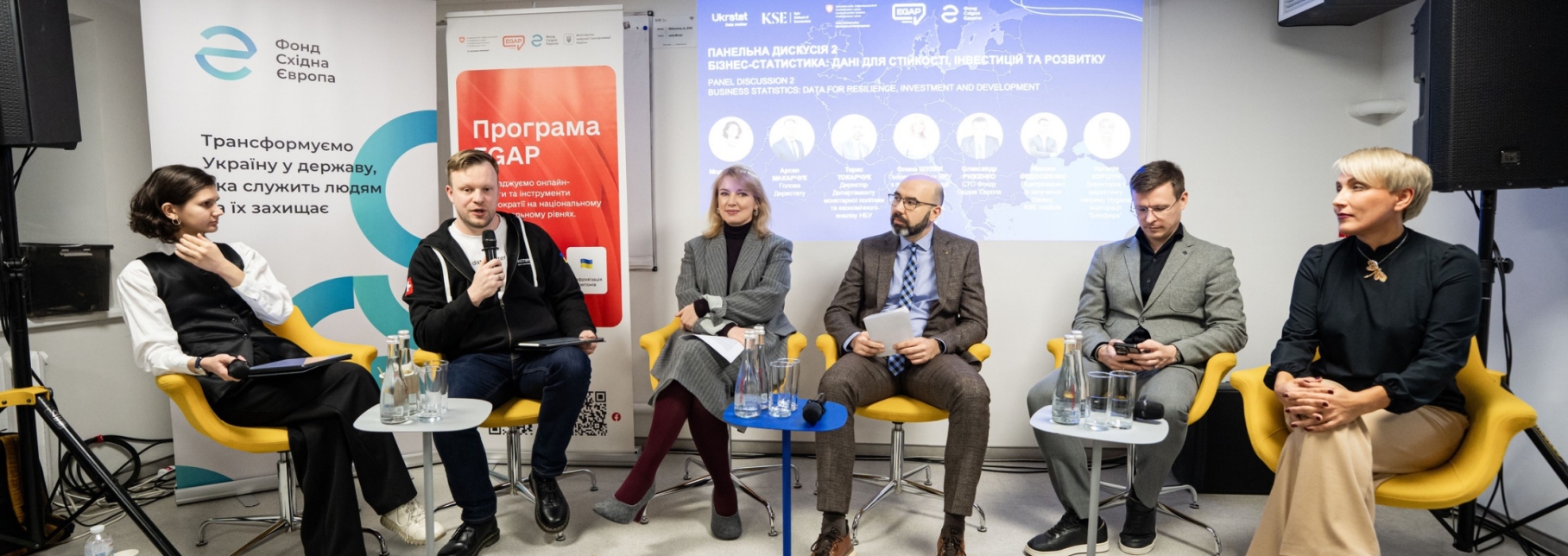
Kyiv, 23 October 2026 – To celebrate European Statistics Day, the State Statistics Service of Ukraine (Ukrstat) and its partners brought together representatives from government, business, international organisations and European statistical offices, as well as analysts, researchers and educators. The event, held at the Kyiv School of Economics (KSE) on 19 October, opened the first European Statistics Week in Ukraine.
The discussions focused on the data that government, businesses, local communities and international partners need to make informed decisions. Participants also explored how Ukrstat is restoring and developing official statistics and aligning Ukraine’s statistical system with European standards. Among the upcoming developments are a new Regions section on the Official Statistics Portal, launching on 1 January 2027, and new results from household surveys.
«Statistics provide the tracks on which the locomotive of Ukraine’s European integration runs. And for that journey to work, the tracks need to be the same gauge. That is what we are doing: adopting European directives and standards to make our statistics comparable. But statistics must also be useful, easy to understand, accessible and available when people need it to make informed decisions,» said Arsen Makarchuk, Chairman of Ukrstat.
He noted that over the past year, Ukrstat had resumed statistical reporting, along with the production and publication of official statistics disrupted by Russia’s full-scale invasion. Household surveys have also resumed, including the first round of the EU Statistics on Income and Living Conditions (EU-SILC) survey.
«Statistics are part of the first EU accession negotiation cluster, alongside the rule of law. This shows just how important it is to Ukraine’s European integration. But first and foremost, we all need data to make management and government decisions based on sound, objective evidence rather than intuition. The Kyiv School of Economics will continue to be a reliable partner to Ukrstat. Our institute works with official statistics, and we are ready to help wherever additional data and research are needed,» said Yuliia Svyrydenko, President of KSE Business School.
«Ukraine needs reliable data to make decisions about rebuilding infrastructure, providing services to people who have moved to new communities, and identifying where businesses should set up production facilities. During wartime, the answers to these questions can change quickly. That makes it especially important to have up-to-date data and to understand where they come from and what they can – and cannot – tell us,» said Oleksandr Ryzhenko, Chief Technology Officer (CTO) at the East Europe Foundation.
What's new on the Ukrstat Portal, stat.gov.ua
At the event, Artem Rudko, Chief Digital Transformation Officer (CDTO) at Ukrstat, presented the latest updates to stat.gov.ua, the official statistics portal launched in November 2025.
The new «Key Indicators of Ukraine’s Socio-Economic Development» dashboard brings the country’s main socio-economic indicators together in one place, making it easier to see the overall picture. It was designed around users’ needs and informed by European experience.
Data are presented in tables and charts, with links to more detailed figures in the data bank and thematic dashboards. The figures are updated automatically from Ukrstat’s data bank, ensuring that the dashboard always displays the latest official statistics.
The dashboard is already available in test mode and is scheduled to go fully live on 1 November 2026, following the final updates and improvements.
Artem Rudko also announced that, from 1 January 2027, stat.gov.ua will bring together data at national, regional, district and territorial community levels, wherever these data are available.
At present, more than 20 separate regional statistics websites operate alongside the main Ukrstat Portal, each with its own interface. For researchers and journalists comparing data across regions, this means having to visit multiple websites.
The new Regions section will change that. Users will be able to select a region and access its news, publications, data bank and regional dashboards through the same consistent interface, with the entire website adapting to their chosen region.
Expert discussions: population data and better decision-making in government and business
The first discussion, «How Many of Us Are There and How Do We Live?», focused on population data. It brought together members of the Ukrainian Parliament and representatives from the Ministry of Economy, UNICEF, KSE Institute and Statistics Estonia.
Ukraine’s latest official population estimate dates back to 1 January 2022. Since then, the war, the loss of control over parts of Ukraine’s territory and large-scale migration have dramatically changed the country’s demographic situation.
Participants highlighted how difficult it is to plan social policies, budget programmes and employment measures without reliable, up-to-date information on the population, including where people actually live and work.
Working with the Institute for Demography and Quality of Life Problems of the National Academy of Sciences of Ukraine and the United Nations Population Fund (UNFPA), Ukrstat has calculated a population estimate as of 1 January 2026 and submitted it to the Cabinet of Ministers of Ukraine.
Household surveys are another important source of information about the population. Together with UNICEF, Ukrstat presented the final results of the Multiple Indicator Cluster Survey (MICS), offering insights into the lives of children, women and families across Ukraine.
The first results from the main interview of the Household Budget Survey have also been published. Results from the Labour Force Survey, including employment and unemployment figures, are expected at the end of October 2026.
Arsen Makarchuk stressed that international experience shows a population census remains the best way to establish the size and composition of a country’s population.
No date has yet been set for Ukraine’s next census. It needs to take place during a period of relative stability so that the results can provide a reliable basis for planning in the years that follow.
Ukrstat is looking towards the 2030 European census round, although whether a census can be conducted will depend on the security situation and the end of martial law in Ukraine.
The second discussion, «How Can We Make Official Data the Basis for Government and Business Decisions?”, brought together representatives from the Verkhovna Rada, the National Bank of Ukraine, the Ministry of Finance, KSE Institute and the business community.
Each shared their perspective on the data they need and the gaps that currently make decision-making more difficult.
For local communities, population data are essential for planning development and public investment. For the National Bank of Ukraine, the lack of labour market data remains the biggest challenge for macroeconomic forecasting.
Businesses need data that are easy to find and understand, accompanied by clear explanations and regional comparisons. For the Ministry of Finance, the quality of data directly affects the quality of budget decisions and, once Ukraine joins the EU, the accuracy of its contributions to the EU budget.
Ukrstat also outlined its plans to develop statistics at the territorial community level, introduce a new area of statistics on the war, and reduce the reporting burden on businesses by making greater use of administrative data.
Following the discussions, Arsen Makarchuk, Chairman of Ukrstat, and Urmet Lee, Lead Expert of the EU4Statistics Ukraine Programme and former Director General of Statistics Estonia, each delivered a lecture to students at the Kyiv School of Economics.
A recording of the official part of the event is available on Ukrstat’s YouTube channel.
The event was organised by Ukrstat in partnership with the Kyiv School of Economics. Both the event and Ukrstat’s digital transformation project are supported by the Swiss-Ukrainian EGAP Programme, implemented by the East Europe Foundation.