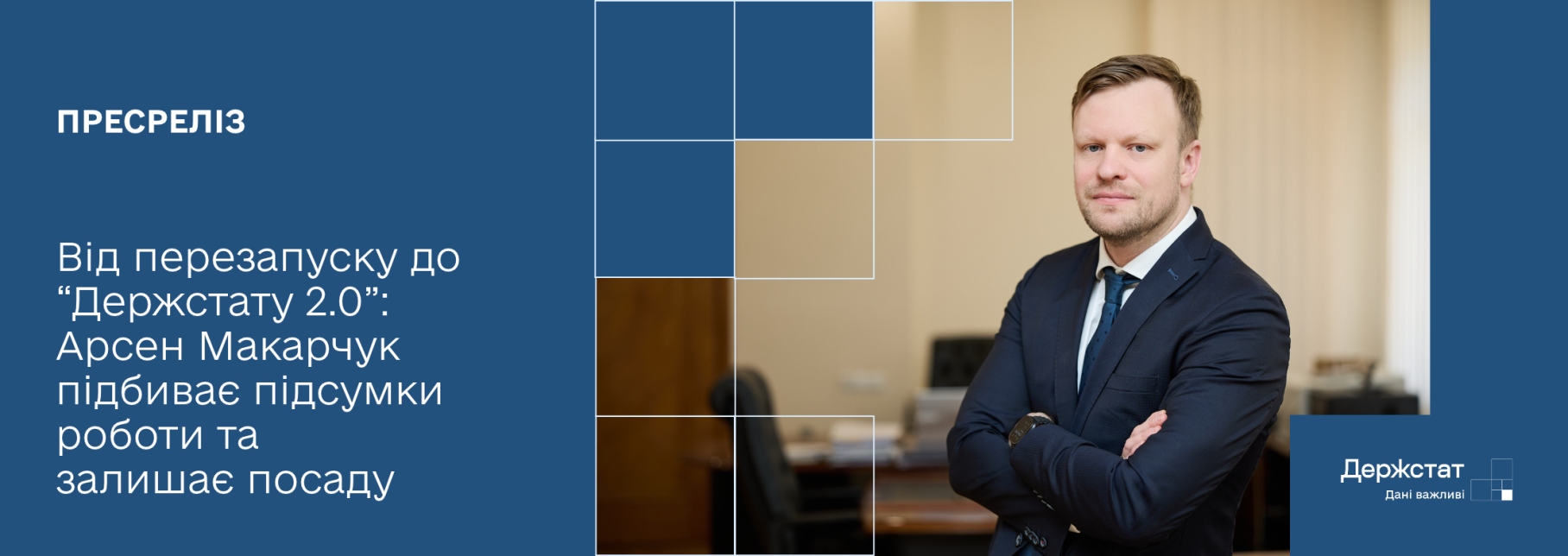
Arsen Makarchuk is stepping down as Chair of the State Statistics Service of Ukraine. The Cabinet of Ministers of Ukraine has accepted his resignation at his own request.
“When I took the helm at the State Statistics Service, the key task was to restore the work of the state statistics system and begin its systematic modernisation. Over almost 20 months, my team and I have achieved the main objective – we have restarted the production and publication of data, streamlined our work on European integration, and set the course for the future. The team of deputies we have formed is ready to continue these changes. I would like to thank all my colleagues and partners for their professionalism, trust and collaboration,” said Arsen Makarchuk.
Under Arsen Makarchuk’s leadership, the State Statistics Service team focused on restoring statistical production, digital modernisation and European integration.
Mandatory statistical reporting, as well as the regular production and publication of data, have been reinstated. Large-scale household surveys, particularly on living conditions and the labour force, have been resumed; the EU-SILC survey, based on European methodology, has been launched; and the MICS survey has been conducted in collaboration with UNICEF.
A new official statistics portal has launched, expanding access to data through interactive tools and the StatGPT AI assistant. The next step was launching a dashboard of Ukraine’s key indicators, bringing together data on the country’s socio-economic development.
Further priorities have been set out in the ‘Ukrstat 2.0’ strategic vision for 2026–2028’. These include developing statistical production, digital transformation, integration into the European Statistical System, and strengthening institutional capacity.
The duties of the Head of the State Statistics Service have been assigned to the CDTO, Artem Rudko.
All Deputy Chairs shall continue to carry out their duties in their respective areas of responsibility. The State Statistics Service team shall ensure the fulfilment of current tasks, international obligations and transformation projects in accordance with the ‘State Statistics Service 2.0’ strategic vision.
For reference. Key achievements of the State Statistics Service during Arsen Makarchuk’s tenure (March 2025 – November 2026)
Restoration of statistical production. Following a hiatus of more than three years, legislative changes made it possible to reinstate mandatory statistical reporting, with around 85 per cent of enterprises having resumed compliance by the end of 2025. This enabled the resumption of regular statistical production and, over the course of the year, the catch-up and publication of more than 90 per cent of statistical data for the years 2022–2025.
The resumption of statistical production also created the conditions for the return of large-scale population surveys after an almost four-year break. From December 2025, the State Statistics Service resumed conducting four household surveys: household budgets, labour force, income and living conditions (EU-SILC), and agricultural activity of the population. The State Statistics Service has already published the first results of the household budget survey on its website.
In collaboration with UNICEF, the first Multiple Indicator Cluster Survey (MICS) in over a decade was conducted, involving more than 16,000 households. Its final results were presented in October 2026.
Digital transformation. In November 2025, the new official statistics portal, stat.gov.ua, was publicly launched – one of the key outcomes of the State Statistics Service’s digital transformation, carried out with the support of the Swiss-Ukrainian EGAP Programme, implemented by the Eastern Europe Foundation. The new portal brings together the Data Bank, interactive dashboards, API-based data access and a search function powered by the AI assistant StatGPT. Over the course of a year of development, it has been supplemented by the ‘Key Indicators of Ukraine’s Socio-Economic Development’ dashboard, which allows users to view key socio-economic indicators in a single window and navigate to detailed data.
Work is ongoing to migrate statistical information from 25 websites of the State Statistics Service’s regional offices to the portal. This is scheduled for completion by the end of 2026, so that from 1 January 2027, national and regional data will be available in a single digital environment.
At the same time, the State Statistics Service is modernising its internal information systems. The transfer of official statistical surveys to the SIGMA digital platform is underway, aiming to automate data collection, processing, and dissemination, reduce manual operations, and improve the efficiency of statistical production.
European integration. In 2025, the State Statistics Service underwent a bilateral screening under Negotiation Chapter 18 ‘Statistics’, which forms part of the first cluster of negotiations on Ukraine’s accession to the EU, opened in June 2026. The transmission of statistical information to Eurostat has been expanded: as of November 2026, over 150 datasets had been transmitted, compared with 100 in 2025. The national classifications NACE 2.1-UA and NUTS-UA, harmonised with European standards, have been approved, and the production of new statistical indicators in line with EU requirements has commenced.
International partnerships have expanded, and additional expert and financial support has been secured to fulfil Ukraine’s European integration commitments in statistics. In particular, the EU4Statistics Ukraine programme, with a budget of 7.1 million euros, was launched in May 2026 and is being implemented with support from the European Union, Sweden, and Estonia. The programme aims to modernise statistical production, strengthen the institutional capacity of the State Statistics Service and further integrate it into the European Statistical System.
The ‘Ukrstat 2.0’ strategic vision. In June 2026, the State Statistics Service presented a strategic vision for its development for 2026–2028. The document sets out five strategic objectives: developing the State Statistics Service’s role as the architect of the national data ecosystem; producing high-quality statistical outputs; modernising digital infrastructure; focusing on user needs; and strengthening institutional capacity. The strategic vision lays the foundation for the next phase of the State Statistics Service’s modernisation. It sets a common course for the team that will continue the changes already underway.